Showing posts with label Information Architecture. Show all posts

Tuesday, November 11, 2014

Ubiquity, Testing, Experience

Ubiquity: that is perhaps the one word contrast between the context of the previous generation of OWL testing and this new iteration. In my last post, I wrote about designing the students' experience of the class. This blog is perhaps clearest evidence of the transition from an OWL redesign project dedicated to Usability and one meant to focus on UxD. In 2006-2007, there were elementary blog hosting services, but now these template-driven hosting services (like this blogger site) are quite sophisticated. The design and function are "good enough" to support our class needs, as well as the demands of documenting and recording the project itself. I think about all the time saved both by students and me, and that time can be spent on reading more recent research as well in articulating this content. The blogging tools are ubiquitous. They're simply here: free, useful, and most importantly, usable.
Just as the resources available on the OWL and the different methods of accessing the information are changing, the methods we use for analysis need to change too. —Kaitlyn
I would be wasting my energy and students' time if we spent this class concentrating on usability to the exclusion of experience architecture. There are limits to the utility of revisiting usability precisely because usability has been so successful. In the middle 1990s, we were making arguments about including usability precisely because so many emergent designs were unusable, either pet projects not meant for widespread adoption or examples of what Norman refers to as "next bench" design, the design solutions engineers come up with that prove a concept at their workbenches but really aren't meant for general, mass use. Usability has broken that scheme and practice, and moved from emergent design (as Bjiker named it) and towards recognizable genres (which Spinuzzi has traced for some time in his work). Bob Johnson has recognized this Ubiquity Paradox and questions insistence on older usability, user-centered, and participatory lexical fixations. 
The OWL needs to make sense. Not just for me, a tech-savvy college student, but also my mom, a middle aged music teacher who does not work with a lot of technologies on a daily basis. It shouldn't make users wonder why they must take certain steps, it should be self-evident. —Jessica
Blogger is a tool we are employing to help create the communication environment of the OWL UxD project. Similarly, Purdue provides access to a sophisticated survey tool, Qualtrics. Other similar tools exist, some at low or no cost for educational use. I've been asked if I might be making students dependent on this tool: what happens when their first professional position requires data gathering and there is no access to Qualtrics? Putting aside whether this or another tool might be better to address the need, it seems silly to deny students use of a powerful tool for fear it might not be available at some unknown future point. Further, comparison with free tools allows students to decide: perhaps Survey Monkey has all the power and flexibility they need. Or perhaps they can then begin the challenging but necessary task of articulating need and gathering materials. 
What makes the Purdue OWL a great tool/resource is that it can be accessed by anyone with a computer and reliable Internet connection. Not only is it easily accessible, it's free. And while it contains the overarching theme of guidelines for writing, many different people access the site for different reasons. How the user experiences the site and his or her satisfaction with it depends heavily on whether or not the site helps in achieving there goals. Therefore, by redesigning the site, we are redesigning the user experience of the site so that it fulfills their needs and helps them achieve their goals. —Kristin
Besides blogging and surveying tools, students have numerous computing devices they carry with them to class, including a variety of smartphones, tablets, phablets, netbooks, laptops, and other writing tools. Most students log on to the classroom computers—which are last-generation iMacs with gigantic integrated screens. But many students rarely if ever log on to these computers, and by extension, also eschew resources like software and storage space available through the wired campus network. Students access materials through the less robust but more flexible wireless connectivity available just about everywhere on campus. WiFi is like oxygen on campus: everywhere and seemingly free, and only noticed in its absence. That is, ubiquitous.
There will be a wide range of things we have to consider while we are creating the user experience to accommodate all OWL users because they have so many different types of users with different access to certain technologies. —Kira
Behavior surrounding the campus network and computing resources has convinced me that one response to ubiquity needs to be a reconfiguration of campus computing facilities. I favor replacing the 20+ student machines with 5 or 6 higher end machines capable of and equipped for HD video editing, 3D sound editing and recording, and student- as well as teacher- controlled image projection. This is how we are reimagining our multimedia production space. And have proposed for our main technology rich classrooms. But I digress. 
The purpose of redesigning the Purdue OWL has shifted from usability to UXD design. I find it interesting ... that usability has come so far and that this is a major reason why we focus more on UXD design... I agree that some major changes could be made to the room. On our redesign of the room, we included more tables and more computers, which will definitely help shape a user's experience. —Andrew
Blogging and surveying tools are part of this new age of ubiquity. Similarly, students' own mobile technologies are part of a literate context that seems to define this new era. That these technologies can be seamlessly accessed and used interchangeably—that they are useful and usable—are part as well of the environmental dimension of technology. That WiFi is not only present but robust, but more importantly expected. In this context, usability testing is much less pressing than attention to the users' experience within this techno-cultural space and place.
We need to begin taking into account all of the different devices that were mentioned in this post. Looking at some of the network statistics from the OWL, very few hits are actually coming from the mobile devices that students carry with them everywhere. While this could be that the content may only be relevant when they are working on an actual computer, I think we need to begin considering how users would interact with a mobile app and what information they may need access to from a device that fits in their hand. Rather than just re-sizing the OWL to pocket form, we need to start thinking ahead to what the needs of the users are. —Tanner
Blogger and other Google docs; email and instant messaging; Qualtrics; the physical classroom itself with its installed computers and full suite of software; campus WiFi; mobile and laptop computers: this mix of devices, software, services, and places all contribute to the instructional technology—they are available to students but can become invisible, transparent—as technologies. These technologies are for the most part looked through to the work at hand precisely because usability as a movement has been so effective. These things just work. So what's at stake?
There are many systems that "just work" without a second thought for me. But as I read this post, I began to wonder whether technologies truly "just work" or if I, as a user, have adapted my interaction with a technology so that it can work. —Jessica
Well, the continued invention and design of new services, and of new categories of devices (I did mention phablets above, which are certainly evolutionary and not revolutionary, but still, a new micro-category). These are important. But I think the bigger rewards lie in taking successful processes and knowledge making from the software and web worlds and putting them to work in new contexts: from workplaces to architecture to manufacturing, there are innumerable contexts where knowledge and core competencies developed in the service of creating these now-ubiquitous technologies and literacy practices make training in technical communication very valuable. In an age of ubiquity, experience architecture is an important and valuable specialty in a wide variety of workplaces.
So, my question is: as different tools for increasing/measurability usability increase, does the assumption that these users immediately know how to use them increase as well? And how do we negotiate these kinds of expectations? How do we need to think more critically about accessibility and, indeed, willingness, to work with and learn from these types of technologies? — Mary
This classroom is the experience of UxD for these students. I have designed it in order to teach these students about usability, user-centered design theory, as well as involve them in ongoing research. I also ask them to think with me, and sometime struggle to make clear what we are doing ... precisely because  I do not yet know. But that's what I take to be my responsibility in this class: I share with students what I know (what I think I know) at this moment about UxD, offer access to ongoing discussions as well as a balanced mix of new, groundbreaking, and foundational research. I bring with me the expectation that their other teachers and the curriculum have prepared them to move from what they have been taught to  the challenges that lie ahead of them. As these quotes I've pulled from their responses show, they have prepared themselves not just to respond to the challenges of Purdue's OWL and its user experience needs, but to address a wider range of challenges posed by valuing user-involved research.

Monday, October 6, 2014

Experience Architecture and OWL


Experience Architecture is the most generalizable expression of creating an environment: it includes analysis techniques like usability and user-centered design, as well as instructional design and information architecture, findability and taxonomy. It is, perhaps, the name for one of the Sciences of the Artificial that Herbert Simon wrote about in 1996. 

Until recently, I had been satisfied that Information Architecture would suffice to describe what I was talking about, but even though I had written about the process and products from a PTC (Professional and Technical Communication) perspective, database, information service, and information technology (IT) communities were still battling over its use, even if Rosenfeld and Moreville had pretty much won on the intellectual merits of the case. When the usability practitioner community changed its name to the User Experience Professionals Association, it became clear that merits be damned. There was change afoot.

Liza Potts, my colleague and friend, had been arguing for some time about the merits of using the title Experience Architecture for what we do. Her reasoning, which I have come to accept, is that as industry and practitioners flit about from term to term, from Usability to Information Architecture to User Experience Design to whatever may come next, that Experience Architecture is a reasonable term for this arena of the administrative arts and sciences of the artificial. Experience Architecture can be “ours" so long as the implied “we" is academe. 

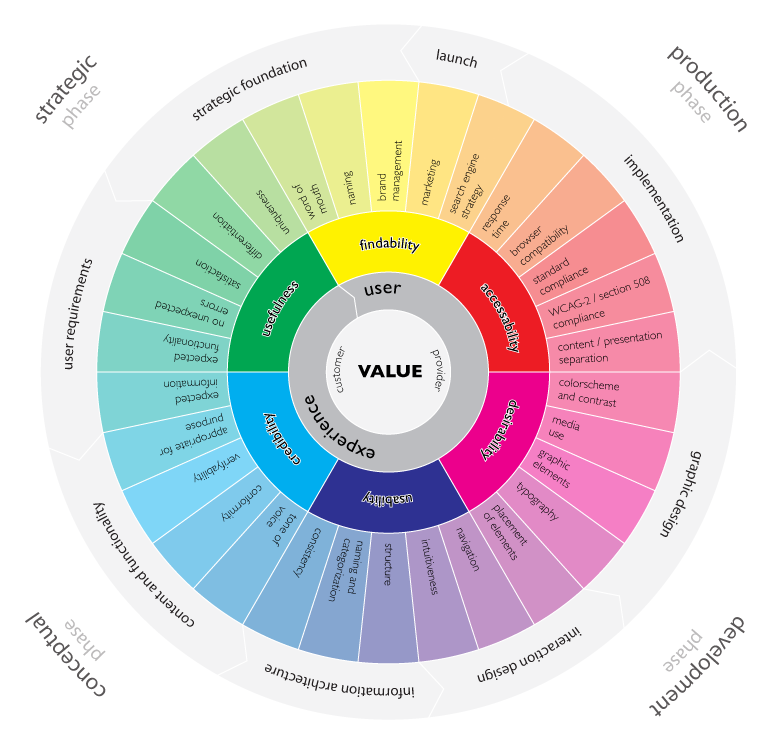
http://www.randsinrepose.com/assets/wheel-large.png
Wheel graphic explaining value of User Experience Design.

So many distinct subfields fit into this moniker Experience Architecture: information design, project management, document management, usability, user-centered design, document design, information architecture, findability, taxonomy: this isn’t a laundry list, at least not to me. These are places on a map, a map called UxD by practitioners and a map I’m learning to call Experience Architecture. 

Every class is an experience waiting both the be experienced and designed. While the OWL Usability Project is a discrete experience, being designed to improve the Online Writing Lab’s online materials more accessible and more user-centered, the class in UxD is also designed to allow students majoring on professional writing to see themselves as future UX professionals. Or, if they do not want to go the route of digital design, to help them articulate their own focus within professional writing.

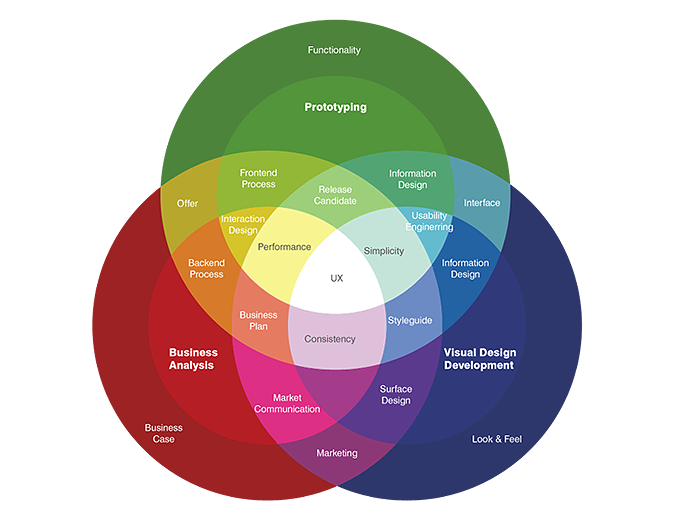
A map of UX presented at UXThought.com

I like to joke with the new majors that if I told them what career they would have at graduation I would be lying to them. Some don’t get it, while others look horrified. But I stand by my assessment: a recent graduate, who is now working for a major museum as their Social Media Coordinator, did what we later came to understand was an internship in social media. But in 2009, it was not clear what the field would be called nor what job titles would be instrumental in advancing the state of the art. Social Media Coordinator is now a thing, and it’s a title that programs and individuals are chasing. But you know what? The opportunities are now diminishing and there are more opportunities in other related as-yet unnamed pursuits.

It is that continuous and rewarding pursuit of the emergent, the new--what my colleague Patricia Sullivan have recently be calling the constant of change. That is what I am after. So it really does not matter if, in my class officially titled “Advanced Professional Writing,” we say we are studying UxD or Experience Architecture, or Social Media. What we are pursuing is the ever-emergent new, and articulating what’s next before it is yet articulated.

Fred Cavazza's 2014 Social Media Map is an iterative design he updates annually.

So we follow and lead: follow where people have made headway. Interestingly, we lead when we feel most lost. And this is what I have to constantly remind students, even those advanced expert graduate students, that when they feel most lost that they are making the best progress. When you are coining new knowledge, you have to feel like you are making it up. Because we are. emergent knowledge, the new, has to be disconcerting, uncanny, and uncertain precisely because its like has never been seen on the planet before, not in this guide, not in this context. And while many are quick to point out that nothing is new, and it’s all remix, all I’ll say is that, in a manner of speaking that is correct. Yet each new contextualization, re-contextualization, reappropriation, and rearticulation is something new that has not yet been experienced quite like this before.

This semester, I am teaching advanced professional writing, the capstone professional writing major class, as Rhetoric & Experience Architecture. Previously, I've taught it as UxD, Information Architecture, and Information Design. Each of these previous versions felt a little constrained, a little tight. The expansive nature of Rhetoric & Experience Architecture allows the class some breathing room: the technologically inclined students are running ahead of the pack with an Eye Tracking Unit from Grinbath as well as a number of techno-gizmos, only to be added for user-centered functionality, of course. But there is a design team, a team dedicated to compiling an OWL style guide (which has been needed for years), as well as a real innovation I have been very happy to support. One mature student has taken on the role of project manager. Every class meeting, this student does the opening introduction to class, recapping what has been accomplished, upcoming deadlines, and what we said we would be doing in class for the day. At the end of class, the project manager recaps the day's accomplishments and forecasts deadlines and content for the next class. It hasn't displaced me as the classroom teacher but it has required me to renegotiate my pedagogy. In class the other day, the project manager led discussion while I took notes. I realized that not only hadn't I spoken for ten minutes, but that no students had turned around to look at me taking notes at the back of the class. That was a new and exciting development.

The class is, by definition, a site of instructional design. It is also a designed user experience—an enactment of all the core competencies at the heart of Technical and Professional Communication (TPC), and a safe space for inexperienced TPCs to try on a number of professional specialties at the start of their final year of study before joining practitioners in the field.

The goal for my class is to help students figure out how to maintain attention to and dedication for their role as user advocates. My goal for the OWL Usability Project is to continue to act as user advocate for the many worldwide millions of users of this wildly successful website that supports so many in their attempt to improve their written English skills. We aim to collect user data only to improve the site — building better experiences through understanding who is accessing existing resources, and through what technologies. We are seeking large numbers of responses to simple questions to see if the users we test more qualitatively represent our wide user base. We are also setting out to collect more metrics to accomplish similar goals. We aren’t interested in finding anything out about individual uses but rather in understanding the statistical probabilities of user patterns, to develop metrics so that we can better anticipate user needs. I invite you to volunteer if you have 5 minutes, 20 minutes, or 90 minutes to give to the OWL. Over the years, many of you have expressed interest in finding ways to give back to OWL, and this is your chance: we need your time, and we need anonymized data that only you can provide.

We know what text books look like from too many years of developing the genre, and we know what patterns of classroom instruction look like. And now, after 20 years, we know at the least what one OWL can look like. But what we don’t yet know is what the next 20 years of OWL might look like, we do not yet know what else is possible with the medium. It is possible that we have reached a dead end. It is also possible that over the next year or so of user inquiry and usability exploration that we might just get lost enough to realize that, in hindsight, we have invented whole new modes of engaging with the OWL’s users, new modes of providing content, and created whole new designs for interaction. That is, we may have just begun architecting the OWL users’ experience.

I hope you’ll join me and these energetic students in the project of inventing new possibilities for designing and sustaining the Online Writing Lab at Purdue.

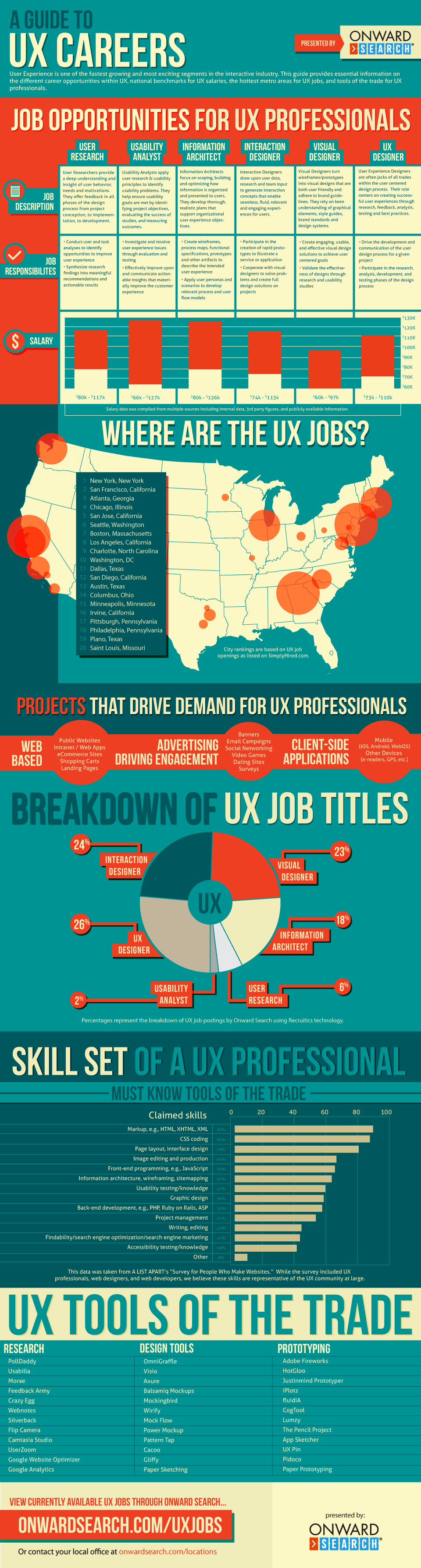
An image containing data about UxD jobs in the US taken from 2013 data.
Taken from the UX Career Guide at Onward Search
http://www.onwardsearch.com/career-center/ux-careers-guide/